SEARCH YOUR QUERY

Friday, October 25, 2024

Deep screening in single rail section, SWR & LWR,

Question - Describe procedure of Deep screening in single rail section, SWR & LWR, pre caution to be observed at site also to be mentioned.


Ans. Due to presence of bad formation abrasion and attrition of ballast, impact loads excessive rainfall, ballast gets chocked up and track drainage is impaired. At this stage entire ballast under sleeper and crib right up to formation level/sub ballast level is removed to improve drainage and running quality of tack, the process is called Deep screening. It can be carried out at following locations:

Short notes For Civil Engineer LDCE & Other Exam (P Way)

  Write short notes

(a) Mean annual rail temperature 

Ans (a): Mean Rail temperature- Denoted at tm for a section, it is the average of the maximum and minimum rail temperature recorded for the section. tm= (tmax +tmin ) / 2 

(b)Stress free temperature 

Ans (b): Stress free temperature- Denoted as to , it is the rail temperature of which the rail is free of thermal stress.

(c) Breathing length in a LWR 

Ans (c.): Breathing length in LWR- Breathing length is that length at each end of LWR/CWR, which is subjected to expansion/Contraction on account of temperature variations. 

Thursday, October 24, 2024

Distressed bridges and schedule of inspection by official

Distressed bridges and schedule of inspection by official.

Definition of distressed bridge:- A distressed bridge is one which shows some physical deterioration of its physical condition, indicating the need for rehabilitation through special repairs strengthening or rebuilding (including replacement of griders).

Classification of distressed bridges

Category - i: Those requiring rehabilitation to be done immediately, say within a year’s time. Category-ii: those requiring to be kept under observation and to be taken up for rehabilitation on a programme basis. Signs of distress for Group I bridges:

Q. & Ans - What are the main cause of crushing of PRC sleeper in washable aprons and what are the remedial measures?

Q.  What are the main cause of crushing of PRC sleeper in washable aprons and what are the remedial measures?

Ans - The washable aprons are constructed on the concrete raft. The PRC sleepers placed on the raft and after palcing of sleeper the crib is casted one bitumen sheet also provided under the sleepers at both ends for facilitating the elastic medium between sleeper and raft. 

Now during casting of crib the concrete as well as cement sullary flows under the middle of sleeper which give the rigid support to the sleeper resulting to this the sleeper becomes centre rigid and ends on elastic support due to this uneven base the sleeper sheared while wheel load comes on the sleeper . 

Inspection and maintenance of Track on Approaches of Bridges

 Inspection and maintenance of Track on Approaches of Bridges :- 

(a) For all Bridges- 

(1) On the bridge approaches, sleepers with arrangements for fixing guard rail should be provided for provision of guard as per Para 275 above.

(2) Full complement of track fitting at bridge approaches up to 100 metres should be provide to maintain required track geometry and effort should be made to immediately recoup deficiency noticed, if any. 

Short Note on Soil Consistency

SOIL CONSISTENCY


The property of soil which is evident by its resistance to flow is called soil consistency.

Consistency helps to understand the degree of cohesion between various soil particles. A fine grained soil thus remain normally in any one of the flowing states:

Short Notes on Imprest Store, Charged of store, Surplus Store

Imprest Store, Charged of store & Surplus Store


 IMPREST STORES:-

The imprest with every subordinate should be fixed by the head of department. The scale of imprest sanctioned for each subordinate should not be increased or decreased except by the authority who originally fixed the scale. Material issued from in present stock should be recouped as soon after the issues as possible. The subordinate concerned may place requisitions for the recoupment of imprest stores direct on the authorized stores Depot. No transfer of stores between imprest holders should be permitted except when stores are immediately required in a particular area in an emergency and are not available at the time with the imprest holder of that area.

Short Note On Thermit Welding quality control

Thermit Welding & its quality control: -

A fish plated joint has been a necessary evil in the railway track right from beginning of railway. To overcome the various problems posed by the fish plated joints and reduced the maintenance cost the need for welding of rail ends was felt. Joining of two rails end by the application of heat is called welding. Among the various tetchiness of welding the AT welding is used now days for scattered and spot welding.

Short Note on TGI & OMS

TGI and OMS :- It is utmost important to ensure passenger comfort and safety of track. In order to improve longevity of assets. This can be achieved by frequent inspection, detection of irregularities and their quick elimination, various method of inspection has been adopted by P.Way engineers.

Short Notes on Buckling of track, Cause and prevention

Buckling of track, Cause and prevention.-

1. Buckling of Track: - When the compressive stresses become higher than the resistance (Lateral or longitudinal or both) offered by the track structure then alignment of track (vertically or laterally or both) distorted, this phenomena is called the buckling of track.

2. Cause:- Any act which reduces the resistance offered by the track such as:-
i. Weakening or removal connections between rail and sleepers such as missing or in effectiveness of rail to sleepers fitting.

Short Note on Works needing CRS Sanction

Works needing CRS Sanction

CRS sanction required for the execution of any work on the open line which will affect the running of trains carrying passengers and temporary arrangements necessary carrying out it. Such as:-

i. Addition, Extension or alteration to running lines. ii. Alteration to Points & Xing in running line.

iii. New Signaling and inter locking installation or alteration to existing installation.

iv. New station temporary or permanent.

v. Heavy regarding of running line involving lowering/raising of track in excess of 500 mm.

vi. New Bridges, Addition or replacement of existing girders including provision of temporary girders.

vii. Provision of new L-Xings, shifting of L-Xing, Demanding and down grading, manning of unmanned L-Xing, Upgrading of L-Xings, Closing down of L-Xings.

viii. Permanent Diversion.

Wednesday, October 23, 2024

Classification of Defects, Marking and Action taken in USFD

 Classification of Defects, Marking and Action taken in USFD:- 

During USFD  testing of rail following to be done.  


Quality Control measures at the Renewal sites of contractors

Quality Control measures at the Renewal sites of contractors 

Quality Control measures at the Renewal sites of contractors:- It is very important to ensure the quality of work at renewal sites as the contractor labour are not careful about to maintains the track parameters within the safe permissible limits. Hence to ensure the track parameters within safe and permissible limits the following measures have been taken.

i. Only qualified and experienced supervisors should be deputed to execute the work.

ii. Contractors supervisors should be qualified and experienced, his knowledge must be examine by the officers not below the post of ADEN and a competency certificate should be issued in this regard.

Short Note on Maintenance precaution in LWR track

Maintenance precaution in LWR track : - 

 Maintenance of LWR is very sensitive and required special attention some of precaution required are as under:-

i. Any maintenance of LWR/CWR should be under competent and trained personnel

ii. Maintenance work should be confined to hours when the rail temperature is between Td + 10 and Td-30. If rail temperature after maintenance operations exceeds Td+20 Centigrade than during the consolidation period speed restriction of 50 Kmph shall be imposed.

Short Note on Permitted Location for LWR

Permitted Location for LWR :-

i. Complete track renewal shall provide with LWR/CWR. Existing rail laid on permitted location may also be converted into LWR/CWR.

ii. New construction/doubling/Gauge conversion shall be opened with LWR/CWR

iii. In goods running lines where condition of all the track component is sound

iv. LWR/ CWR shall not be permitted where rails are subjected heavy wear,

corrosion and needing frequent renewal

Short Note on Stock Sheet

Short Note on Stock Sheet :- 


 Departmental verification of stores under subordinates is done by stock verifiers of the account department at a specified frequency. Who often physically verified the store entries in their field book.The report of verification is furnished by the stock verifiers in a standard form called stock verification sheet or stock sheet. 

 During verification, stock sheet for irregularities if any is prepared in four copies. Original copy is sent to account officer explanation of the stock holder is recorded on second & third copy and submitted to Divisional Engineer whom retains third copy and forward second copy to account officer for further action. Forth copy is kept as office copy by stock holder.

Short Note on Main duties of ADEN

Main duties of ADEN:- 

 ADEN is generally responsible for the maintenance and safety of all way and works in his charge for the accuracy, quality and progress of new work and control over all expenditure in relation to budget allotment. Main duties of ADEN are as under:-

i. Inspection and maintenance of track and all structures in a satisfactory and safe conditions.

ii. Preparation of plans and estimates, execution and measurement of works including track works.

Short Note on Imprest Store

Imprest Store: - 

The store which is not meant for any specific work but are held in advance to meat out the emergences such as accident/derailment or to carry out the emergent renewal. These stores when used during accidents are debited to revenue and when used directed for emergent renewal are debited to DRF.

Short Notes on Selection of ceramic/vitrified tiles for building work

Selection of ceramic/vitrified tiles for building work : - 

Floor and wall tiles of appropriate design, color and texture enhance the touch and feel of a building. However, the aesthetic improvement potential may not be achieved if proper tiles are not selected. In public area there is a need to choose good tiles of reputed manufacturers confirming IS: 15622 having wear resistance and anti skid properties, modern design, color combination and scheme of laying. Types of Pressed Ceramic/Vitrified Tiles:- 

i) Ceramic Wall Tile: These tiles have high water absorption, due to high water absorptions these tile stain after contact with liquids.

Short Notes River Training protection work

River Training and protection work :- The object of river training/protection work is to prevent the river from damaging railway Formation Bridge and other structure. The following type of river training works is generally adopted in the Indian Railway:-

a. Guide Bunds: Guide bunds are meant to confine and guide the river flow through the structure without causing damage to it and its approaches.

b. Spur/groyne : It is structure constructed transverse to the river flow and is projected from the bank of the river.

Guideline for Disposal of Human Waste

 Guideline for disposal of human waste: -

Discharged from water closets urinal, sinks, cattle shad gullies etc. is known as soil waste. W.C. with sufficient water arrangement required to provide for disposal of human waste. Further connection WC has been done following manner.

i) Where water availability is sufficient and sewer line laid –by providing flushing cistern Further the sewage from sewer line connected into the treatment plant.

Short Note on Disinfection of water

Disinfection of water :- Disinfection of water is required to remove disease producing organisms before it enters distribution system. The material used for disinfection of water is called disinfectants. A good disinfectant should economical and easily available in bulk quantity. It should destroy all harmful bacteria and other organisms. There should be no sludge formation in water. Working of plant, mixing of disinfectant should be simple after disinfectant, the water should not be come toxic and carry no objectionable odour and task. The dose should be such that there is always some residual concentration for protection of water from contamination during storage and conveyance of water through distribution system.

Short Note On Transitions, safe speed and super elevation on curves

 Transitions, safe speed and super elevation on curves  

1) Cant or super elevation is the amount by which one rail is raised above the other  rail. It is positive when the outer rail on a curved track is raised above inner rail  and is negative when the inner rail on a curved track is raised above the outer rail. 

2) Equilibrium speed is the speed at which the centrifugal force developed during the  movement of the vehicle on a curved track is exactly balanced by the cant  provided. 

Short Note On Distressed bridges

Distressed Bridge:- A distress bridge is one which show any physical sign of deterioration of its physical condition, indicating the needs for rehabilitation through special repairs, strengthening or rebuilding (including replacement of girders) 

1. The DEN/Sr. DEN, while including a bridge in the distressed bridge list should also indicate the priority classification depending on nature and severity of distress as detailed below:- 

Short Notes on Track Tolerances

Track tolerances. 

1. TRACK MAINTENANCE TOLERANCES (EXTRACT OF PARA 607(2) OF IRPWM) 

Track  Tolerances  for  standard  of  maintenance  of  track  for  sanctioned  speed  above 100 KMPH and upto 140 KMPH. 

Short Note On Schedule of Inspection of Bridges

 Schedule of inspection of bridges


The schedule of inspection for various officials is prescribed in Indian Railways Bridge Manual (IRBM). As per this, all the bridges are to be inspected by PWIs/ IOWs once a year before monsoon and by AENs once a year after monsoon, and important bridges by DENs once a year.

Short Note on Numerical rating system (NRS)

Numerical rating system (NRS)

a) The “Numerical Rating System” for bridge inspection assigns a “Unique Rating Number” (URN) to represent the physical condition of a bridge. Lower the URN more serious is the deteriorated condition of a bridge. The system thus helps in identifying progressive deterioration in the condition of a bridge. URN can be stored in a computer for quick retrieval and fixing priorities for repairs or rehabilitation. 

b) The URN of a bridge is arrived at based on the condition of components and a “condition rating number” (CRN) assigned to each of them. The various components of a bridge in sequence, are : i. Foundations and flooring, if any, ii. Masonry / concrete in substructure, iii. Training and protective works, if any, iv. Bed blocks, v. Bearings and expansion arrangements, vi. Superstructure – Girders / Arch / Pipe / Slab etc. vii. Track structure.

Monday, October 21, 2024

Short Notes on Pre & post tamping operations for TRT machines.

 Pre & post tamping operations for TRT machines. 

TRT machine is being used for carrying out TRR and TSR simultaneously in the field. 

Pre-Tamping operation :

i. Field survey should be carried out to determine existing profile of track and to decide the general lift. In case of design mode working, the survey should be done as per guidelines.

ii. The beginning and the end of curves/ transition curves should be marked on sleepers. Super- elevation and slew should e marked on alternate sleepers to act as guide for the operator. 

Short Note on Quality of drinking water

Quality of drinking water

Quality of drinking water - It should be ensured that the water supplied for domestic and public consumption is clear, potable, and free from pathogenic organisms, undesirable taste and odour. Water should be of reasonable temperature and free from minerals which could produce undesirable physiological effects. The physical, chemical and bacteriological standards should be as per IS 10500.

Short Note on Chlorination Practices

Chlorination Practices :

There are generally two practices as explained below :-

(i) Plain chlorination : This is applied where water is relatively less polluted and sufficient contact period of at least 30 minutes between the point of chlorination and consumer point is available.

(ii) Super chlorination : This is adopted in case of water being heavily polluted or where available contact period is short i.e. less than 30 minutes. In case of super chlorination, it may be necessary to go in for dechlorination to remove the excess residual chlorine.

Short Note on Chlorine demand

Chlorine demand

When chlorine and chlorine compounds are added to a water source, it purifies the water by damaging the cell structure of bacterial pollutants, thereby destroying them. The amount of chlorine needed to do this is called the chlorine demand of the water. The chlorine demand varies with the amount of impurities in the water and therefore the chlorine demand of a water source will vary as the quality of the water varies. Chlorine and chlorine compounds are consumed by inorganic and organic matters present in water before any disinfection is achieved.

Short Notes on Residual Chlorine

Residual Chlorine:

Residual Chlorine is a low level of chlorine remaining in water after its initial application. This is an indicator that Chlorine Demand is satisfied. It constitutes an important safeguard against the risk of subsequent microbial contamination after treatment The provision of IRWM 2000 are as under:

Short Note on Hot Weather Patrolling

HOT WEATHER PATROLLING

Period for hot weather patrolling shall be laid down by the Chief Engineer for each section and patrol charts prepared where necessary. Patrolling shall be organised by PWI accordingly. In addition, the PWI/PWM and the Gangmate shall be vigilant during summer and on hot days. Hot weather patrolling will also be introduced, when the rail temperature rises above td+25 degree Centigrade 

1. Hot weather patrolling will be carried out as follows:-

Short Note on Various Methods of Chlorination in Railway Colonies and Station

Definition - It is the method of disinfection by which the micro organisms are killed in chlorine. Chlorination serves not only for disinfection, but as an oxidant for other substances (iron, manganese, cyanide, etc) and for taste and odor control in water and wastewater. Other chemical disinfectants include chlorine dioxide, ozone, bromine, iodine. The last two chemical are generally used for personal application & not for the public water supply.

Short Note on Inspection of Fob and Other Steel Structures

 INSPECTION OF FOB AND OTHER STEEL STRUCTURES 

Every structure on the section/sub division shall be inspected in details by the section engineer (works) and Assistant Engineer.


Short Note on Inspection of LWR

Inspection of LWR 

While requiring less maintenance, LWR / CWR necessitate intensive inspection at supervisory and officer’s level.The profile of the ballast section shall always be checked, especially at pedestrian/ cattle crossings, curves, Approaches of level crossings, points and crossings and bridges. Cess level should be correctly maintained. Replenishment of ballast shall be completed before the Onset of summer. Inspection shall be more frequent in the afternoons during summer months. During inspections, look out shall be kept for kinks, incipient buckles and checks made on functioning of the patrols. Knowledge of staff in regard to prescribed maintenance practices shall be periodically checked and it shall be ensured that the work is done accordingly. Ultrasonic examination of rails should not be in arrears. Defective rails / welds should be replaced expeditiously. Inspections of gaps at SEJ and creep / movement at centre of LWR / CWR by Permanent Way officials would be done as per following schedule:-

Short Note on Rail Clusters

 Rail Clusters 

Rail clusters are used for temporarily supporting the track for spans upto 3.66m(12ft).These are designed for M.L standard loading with 10% impact.90 Ibs.&75 Ibs. rails are normally used for the rail clusters. Number of rails required for 90Ibs & 75 Ibs section. Temporary arrangements with rail cluster on sleeper cribs 16.17

Short Note on Sleeper Cribs

Sleeper Cribs:-

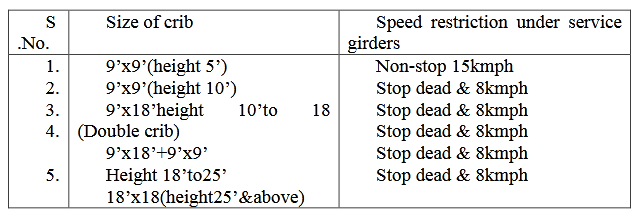
Sleeper Cribs are required for supporting the rail clusters or Service spans at a particular height. Sleeper cribs are designed for a base loading of 1 Ton/Sq ft. If it is considered that soil is not fit for this loading, boulders must first be laid in such a manner as to spread the load until a safe bearing pressure is reached. The top surface of boulders is leveled with smaller stones to form an even surface for the first layer of sleepers. Single Cribs of wooden sleepers are made for height up to 3.05 meters (10ft),whereas double cribs are made for greater heights.

 Following points require special attention during construction of cribs.


(i) Size of crib depends upon the type & span of temporary girder and nature of rail.

(ii) Cribs should be constructed of good sound sleepers of size 2750x250x130mm(9’x10’x5”).

(iii) Sizes of sleeper cribs ranging from 1.525m to 7.625m(5ft to 25 for height and above along with speed restriction generally being followed for each, are given below:


(iv) Rails in sleeper cribs should be introduced at more than 1.83m(6’) interval in height.

(v) A layer of kacha plaster 75mm(3inches) thick should be laid on all exposed surfaces o the crib after the track has been laid to prevent danger from fire.

(vi) Should the height of the crib exceed 1.5m(5’),the cribs should be suitably tied with through bolts.

(vii) A watchman, equipped with fire fighting appliances such as fire buckets etc. should be employed to deal with any fire that may break out on the cribs.

(viii) Cribs forming abutments have to take the side thrust due to earth pressure of the embankment, apart from the load of the Engine& the train, and therefore such cribs require special attention. Normally an auxiliary crib is used behind the main crib to lower the plane at which the live load is applied and reduce the horizontal earth pressure on the main crib.

(ix) The arrangement of sleepers directly below the girder seating should be so done that the concentrated load gets spread over the length & breadth of cribs 16.26.

Short Note on Railway Affecting Works (R. A. W.)

Railway Affecting Works : 

Railway Affecting Works are those, the construction, defective design,  maintenance of operation of which may cause serious damage or breaches or flooding of Railway line or bridges. Some of the examples are:

(i) Irrigation and Water supply tanks or reservoirs

(ii) Canals in embankment and river bunds

Short Note on Types of Bearings in Bridge

Types of bearings in bridge

1. Shoe-plates: Shoe plates are attached to the underside girder and these rest directly on masonry. This is an unsatisfactory arrangement, as due to figh action between masonry &steel, expansion is resisted and heavy longitudinal and forces are imparted to the masonry, these type of bearings are gradually being replaced by centralized bearings.

Short Note on Causes of Rehabilitation of Bridges

Causes of rehabilitation of bridges 

i. Causes of Rehabilitation A bridge may require rehabilitation on account of the various reasons some of the reasons may be as under:

(i) Physical distress 
(ii) Vulnerability on hydrological consideration 
(iii) Use of obsolete/non standard materials such as 

a. Early steel girders 
b. Laterite stones 
c. Cast iron screw piles 
d. Corrugated steel pipes
e. Earthen ware pipes In case, due to introduction of new rolling stock, existing bridge is not safe, both its strengthening is to be done and, if not possible, rebuilding is to be done. 


Short Note on Monsoon patrolling

Monsoon patrolling -

The sections, which are normally to be patrolled during monsoon will be identified and notified by the Divisional Engineer. For every such section, the Divisional Engineer shall prescribe the period of year, when normal monsoon patrolling is to be done; patrolling should be started on these notified sections on the dates specified. If the local conditions warrant, the Permanent Way Inspector of the section concerned may introduce or continue night patrolling outside the stipulated dates, duly advising all concerned

Short Note on Calendar Hamilton span

Calendar Hamilton span

• The modern day pref abricated Panel/Floor Beam/Deck system was first patented by A.M. Hamilton in 1935

• The bridge was used or quick mobilization to allow military access to remote locations or to replace destroyed bridges in times of conf lict.

• The design was centered on a series of gusset plates that allowed the direct attachment of the longitudinal, diagonal, vertical, and cross framing members.

Short Note On Controlled Concretes

Controlled Concretes :- 

These mixes the performance of the concrete is specified by the designer but the mix proportions are determined by the producer of concrete, except that the minimum cement content can be laid down. This is most rational approach to the selection of mix proportions with specific materials in mind possessing more or less unique characteristics. The approach results in the production of concrete with the appropriate properties most economically. However, the designed mix does not serve as a guide since this does not guarantee the correct mix proportions for the prescribed performance.


Sunday, October 20, 2024

Short Note on Census of Level Crossings

Census of Level Crossings 

Periodical census of traffic at all level crossings, unmanned and manned should be taken at least once in three years to review the classification, 

Census of a level crossing is measured in terms of TVU which is obtained by multiplying the number of trains with the number of road vehicles passing over the level crossing in 24 hours.

Short Note on Cant deficiency & Cant Excess

Cant deficiency & Cant Excess

Cant deficiency occurs when a train travels around a curve at a speed higher than the equilibrium speed . it is the difference between the theoretical cant required for such higher speed and the actual cant provided. In normal – 75mm , special case- 100mm. For A&B route with the permission of CE.

Cant excess occurs when a train travels around a curve at a speed lower than the equilibrium speed. It is the difference between the actual cant provided and the theoretical cant required for such lower speed. Limiting value – 75mm.


Short Note on Greasing of ERCs,

Greasing of ERCs, 

1. Following action therefore , is to be taken while greasing of ERC.

i. Greasing of ERC’s should be done by the keyman in PSC sleeper track. Keyman should carryout greasing of ERCs in a systematic manner from one end at the rate of 20 sleepers (80 clips) per day. Greasing should be planned in such a way that entire length of beat is tackled once in a year, however, in severe corrosion prone areas greasing of ERC’s shall be done once in six months. The severe corrosion prone areas are listed in CE’s circular no 260 to supplement the efforts of keyman, each gang shall also be engaged to grease ERCs in their respective gang beat as it will not be possible for keyman alone to complete the work. In addition to greasing by keyman it shall also form part of systematic maintenance of track by the gang.

Short Note on Maintenance of Insulated Joints.

Maintenance of insulated joints.

For efficient and trouble free maintenance of insulated joints, following precaution should be taken:

i. Insulated joints must be maintained as square joints and in any case the distance between staggered joints should not exceed the minimum wheel base of the vehicles.

ii. Rail ends, where insulated joints are fitted must be square and true. Battered ends must be eliminated by cropping and the gap between the rails, if excessive, must be reduced.

Short Note on Pile Foundation

 Pile foundation.

Pile foundation are slender, circular member of timber, hollow pipes, or RCC , either driven or cast in situ. Due to slender ness pile are not used in those bridges where scouring are involved. Pile are classified as under.

Short Note on Tiles and Chequered Tiles

Tiles and Chequered Tiles.

Tiles - The tiles are very important building material for floor and dado treatment and kitchen bath & toilet walls and flooring .The tiles shall be of approved Indian manufacture and conform to specifications IS:777-1970. They shall be flat and true to shape and free from cracks, chips, craze, specks, crawling or other imperfections detracting from the appearance. The glaze shall be either glossy or matt. The body of the tile on fracture shall appear fine grained in texture, dense and homogeneous. The special consist of cove- bases, angles, beads, round edge tiles, corner cups, ridge and legs etc.

Short Note on Components of the Well Foundation

Components of the Well Foundation :


(I)Well Curb and Cutting Edge :

a. Bottom portion of the well is tapered and is called well cur

b. It should be strong enough to transfer the design load. Cutting edge, which is integral part of the well curb, is usually made of rails or mild steel plates and angles. Edge of the cutting is sharp to facilitate cutting of soil. Inclined portion of the well curb facilitates easy sinking. After the well curb, outer dimension of the well is very slightly reduced. and this facilitates in reducing skin friction, while sinking the well.

Short note on Water closets and urinals, Flushing cisterns, wash basin.

Water Closets and Urinals : The sanitary fittings which receives the human excreta directly and filled with a S or P trap for water seal to prevent the entry of foul gases backward from the soil pipe, is called a water closet.

Urinals : A system receives of urine is called urinals.

Short note on Licensing Railway Land cultivation

  LICENSING OF RAILWAY LAND FOR CULTIVATION 

 (I) Unused/unlicensed cultivable land should normally be utilized for afforestation purposes only. 

(ii) Land given to State Government for GMF scheme should be taken back for afforestation. 

(iii) Land licensed to outsiders should be taken back on expiry of current license terms and to be used for afforestation except on grounds of compassion or in case of those belonging to the categories of scheduled castes/scheduled tribes, landless poor or other weaker sections of Society on the specific approval of G.M. 

Short Notes on Water Supply distribution System

Water Supply distribution System : System depending upon the general topography of the area. Local conditions, orientation of the road. 

The types of system is as under :- 

(I)Dead end system or Tree System : In this system a main pipeline is laid in the centre of the area from where a numbers of sub-mains originate. Each sub-main is further sub-divided into branches pipes called laterals.


(ii) Grid Iron System : In this system the main sub main and branches are all inter-connected with each others. This system is most suitable for the cities having roads.

(iii) Ring System : In this system the main pipe lines is laid around the area in a closed ring either circular or rectangular. 


 (iv) Radial System : In this system water from main pipes is pumped to the distribution resevoir at the centre of the location of the localities.


Saturday, October 19, 2024

Short Note on Completion report

Completion report

The object of a completion Report is to compare the cost of work actually constructed with those provided in the last sanctioned estimate. The completion report of a project duly verified by the Accounts Officer should be submitted to the Railway Board within 18 months after the end of the financial half-year in which the completion estimate is submitted. It should state the expenditure in the same details as the abstract estimate sanctioned by the Railway Board and should indicate any material modifications thereto. In addition it may contain such other information as would in the opinion of the Railway Administration be of interest to the Railway Board. 

Short Note on Grow More Food Scheme

GROW MORE FOOD SCHEME:- 

Under this scheme, the licensing of surplus railway land to railway employees is permitted in all type of railway land whether in urban or non urban areas for group C & D railway staff only. Preference should be given to gatemen, gang men and staff belonging to SC/ST/OBC category and those belonging to the economically weaker section of the society. This policy of licensing of surplus railway land shall be governed by the following stipulations/guidelines:-

Short Note on Safety at P. Way Work Site

Safety at P. Way Work Site  :- The following measures should invariably be adopted for ensuring safety at P.Way Works sites:-

i. The contractor shall not start any work without the presence of railway supervisor at site.

ii) Wherever the road vehicles and/or machinery are required to work in the close vicinity of railway line, the work shall be so carried out that there is no infringement to the Railway's schedule of dimensions. For this purpose, the area where road vehicles and/or machinery are required to ply, shall be demarcated and acknowledged by the contractor. Barricading shall be provided wherever justified and feasible as per site conditions.

Short Note on Distressing of LWR

Distressing of LWR

When is distressing Necessary:- Whenever there is abnormal behaviour of LWR as indicated below, distressing should be done:

i. Gaps at SEJ : whenever the gap observed at SEJ differs beyond limits specified or exceeds the maximum designed gap of SEJ or when stock/tongue rail crosses the mean position.

ii. After special maintenance operation: After special maintenance operations viz. Deep screening, lifting or lowering of track major realignment of cures sleeper renewals other the casual renewals and rehatibiliation of bridges and formation causing disturbance to track.

Short Note on Winter Precautions

Winter Precautions

1. Winter de- stressing should be carried out to reduce the temperature forces wherever due, to check the occurrence of Rail/weld fractures and record of such de-stressing should be maintained.

2. Majority of fractures occurs, when the rail temperature is minimum during early hours in the morning. To detect the fractures during winter months, Kerman’s duty roster should be changed to have early morning patrol so that failures, if any can be detected in time, in addition to cold weather patrolling to be carried out as per stipulated instructions.

Short Note on Maintenance of CMS Xing

Maintenance of CMS Xing


(i) The procedure followed for inspection and maintenance of ordinary points and Crossings should be followed in the case of CMS crossing also.

(ii) Due to heavier weight of the CMS crossing the sleepers under the crossings are likely to develop a concave shape in the central portion tending to minimize the life of wooden sleepers it is therefore, important that the crossing sleepers are well- packed.

Short Note on Setting Out of Circular Curve by Theodolite and Tape Method.

Setting Out of Circular Curve by Theodolite and Tape Method.

i) First of all the tangential angles δ 1 , δ 2 , δ 3 etc are calculated by the formula given below.

δ1 = 1718.9 X C1__ minutes
R δ 2 = 1718.9 X C2 __ minutes
R δ 3 = 1718.9 X C3 __ minutes and so on R

Also the total deflection angel

for the 1st Chord 1 = δ 1

For 2nd chord 2 = δ 1 + δ 2

For 3rd chord 3 = δ 1 + δ 2 + δ 3

ii) Then set up a theodolite over the first tangent Point T1 and level it.

iii) With both the plates clamped at Zero, dissect the telescope to the ranging rod at the point of intersection B and bisect it.

Short Note on How to arrest the weld failure.

How to arrest the weld failure.

1. In case of welding of rail on cess, full rail length should be supported on at least ten wooden blocks either side of proposed weld and rails should be properly aligned spiked and held in position. Welding should be carried out on proper cess and not on the ballast shoulder.

2. In case of in-situ welding, rails fastenings of at five sleepers on either side of proposed weld should be loosened.

3. Ensure that rails are with nil battering & nil hogging at their ends.

Short Notes on Maintenance of PRC sleepers

Maintenance of PRC sleepers

(I) Concrete sleepers should normally be maintained with heavy on track tamers. For spot attention, off track tampers may be used.

(ii) Only 30 sleeper spaces are to be opened out at a time between two fully boxed stretches of track of 30 sleeper lengths each in case LWR track exists.

(III) The concrete sleepers should be compacted well and uniformly to give a good riding surface centre binding of mono block concrete sleepers should be avoided and for that purpose the central 800mm. Of the sleeper should be hard packed.

Short Note on Fabrication of Glued joint IN SITU

Fabrication of Glued joint IN SITU.

 General:- 
1. Glued joints are laid at place where insulation of rails as well as continuity of rails is required .

2. Normally Glued joints are fabricated in shop floor and transported to the site however as the glued joints fabricated at the site save effort needed in transportation and also save at least two thermit welds. Welds. Which are a weak link in track. Repairs to a failed/damaged glued joint can also be conveniently done at site, carefully fabricated glued joint in the field can given as good a service as a shop fabricated glued joint.

Short Note on Blanketing Material

Blanketing Materia :- A layer of specified coarse, granular material of designed thickness provided over full width of formation between sub-grade and ballast is called BLANKET.

The main functions of the Blanket layer are as under:-

i. It reduces the traffic induced stresses at top of sub-grade to a tolerable limit to avoid track foundation failure.

Short Notes on Venerable location & Manson precaution

Venerable location: 
Venerable locations are those spots in the track gridges etc where there is possibility of failure exists due to the constructional as well as natural conditions. These locations are listed and keep in the office. These location should be inspected quickly. In case of extreme whather condition these locations should be watched regularly to check out any damage.

Mansoon precaution:-

a. Monsoon Precautions 

 1. All catch water drains and side drains must be cleared of silt, vegetation and other obstructions to be ensure free flow and quick drainage of storm water. The waterways of bridge must be cleared of vegetation and other obstruction. If silting is noticed some span, it should be removed to ensure that the full waterways is available for the discharge of flood water, During desilting, care should be taken to remove the silt only up to the bed level. 

2. Protective and river training works must be maintained in good condition and repairs carried out wherever necessary. Scour holes should be filled with boulders. 

Short Note on Chlorination of Water

CHLORINATION OF WATER :-


The process of disinfection of water with the use of chlorine in its various forms is called the chlorination of water. It is cheap, reliable, easy to handle, easily measurable and above all, it is capable of providing residual disinfecting effects for long period, thus affording complete protection against future recontamination of water in the distribution system.

Generally following three methods are adopted for chlorination of water using different chlorine producing agents.

(a) Bleaching powder solution is added to the water, the chlorine available in bleaching power is used to disinfect the water. This method is suitable only for smaller requirement of water.

Short Note on Active Earth Pressure & Passive Earth Pressure

ACTIVE EARTH PRESSURE AND PASSIVE EARTH PRESSURE :-

The magnitude of the lateral earth pressure depends upon the movement of the retaining wall relative to the backfill and upon the nature of soil. Considering a rigid retaining wall with a plane vertical face, backfilled with cohesion less soil. If the wall does not move even after filling the material, the pressure exerted on the wall is termed as Earth Pressure at Rest. The point A represent it is fig. below:-

Short Notes on Concrete Mix Design

CONCRETE MIX DESIGN:- The concrete mix design is a process of selecting suitable ingredients for concrete and determining their proportions which would produce, as economically as possible, a concrete mix of necessary workability in plastic stage and provide required strength and durability in hardened stage.

Cement , Sand, Coarse aggregate are mix in a certain proportion which can be 1:4:8, 1:3:6, 1:2:4, 1:1.5:3 i.e. M-10, M-15, M-20 grade of concrete such mixes are known as nominal mix and prepare by volume or weight batching. However if grade of concrete exceed M-20 than proportion of ingredients design in lab than implicated in filled. Such higher grads of concrete are complemented by inclusion of admixture so as to achieve higher compressive strength. Proportion of such admixture are essential in mix design to get more workability with less water cement ratio. Design mix is adopted in important nature of works and a weigh batcher is also must at site to mix proper weight of ingredients. 

Short Notes on Design of concrete mix

 Design of concrete mix

The aim of concrete mix design is to determine the proportions in which cement, fine aggregate, coarse and water should be mixed to produce concrete of required strength, workability and durability with minimum cost.The design of concrete mix can be done following methods. 

Short Notes Optimum moisture content & maximum dry density

Optimum moisture cement:-

the maximum moisture content in the soil after which the addition of water creates hindrance in bringing the particles closer is called optimum moisture content.

If the moisture content of the soil is more than the optimum moisture content, no compaction of the soil is possible because of too wetness.

Short Notes on Contour & Contour interval

 Contour & Contour interval :- 

A contour is an imaginary line on the ground joining the points of equal elevation. The elevation and depression on the map are shown by means of contour. All the points on the same contour have same elevation above datum surface. The line joining those points on map is called contour line. 

Contour interval is the difference in levels of two successive contour line, It may be 5 mitrs, 10 mitrs, or 50 mitrs or even 100 mitrs depending upon the purpose and scale of the map.

Short Note on Duties of Gateman

 Duties of Gateman :- Gateman is an important person and he should ensure safety at level crossing by performing following duties. 


i. Alertness: He should be alert and be prepared to take immediate action in case of an emergency. The keys of gate should be on his person. 

 ii. Position during passages of train: The gateman should stand facing the track on the gate Lodge side of the approaching train. 

Short Note on Frequency of USFD testing of Rails

Frequency of USFD testing of rails:- 

USFD testing is very important activity as by this mean various flaws developed in the rails are being detecting in the advance. Frequency of USFD testing is depends upon GMT of the sections.

At present frequency is as under.

Short Notes on. Honey Combing of Concrete & its prevention

Honey combing of concrete & its prevention.


Honey combed

For laying roofs slab , loose centering should not be permitted where vibraters are used otherwise the bottom of the slab will be honeycombed .

Preventions

1. Centring should be made of steel or strong wood of which joints should be water tight.

Short Notes on Renewal of Rail On Major Bridges & Their Approaches

RENEWAL OF RAIL ON MAJOR BRIDGES AND THEIR APPROACHES –

Renewal of rails on major bridges and their approaches shall be done after passing of 50% of the stipulated GMT of rail as per the rail section. There should not be any fitted, corroded, wheel burnt rail on bridge or its approaches. Regular visual examination and pre winter USFD testing of rail/welds shall be carried out invariably. New rails should not be unloaded on bridge itself to avoid any infringement to passing trains. Uniform rail section shall be maintained on bridge and its approaches upto 100m on either side.

Short Notes on Handling of 90 UTS Rails

HANDLING OF 90 UTS RAILS


1. PROTECTION OF STRAIGHTNESS- Barely visible straightness deviations, for example, a deflection of 0.75mm over 1.5 meters span renders a rail unacceptable and require careful handling and
stacking therefore.

AVOID- 1. Heavy static loading

2. Sudden impact of dynamic loading

3. Localised point on line contact loading in stacking.

4. Excessive end drop and flange overlaps while lifting/moving.

5. Criss – Cross stacking of rails of alternative layers at rightangle as far as possible. DO


1. Keep rails horizontal and straight while lifting/moving.

2. Stack rails of same length on firm level base of well drained platform, preferably of concrete.

3. Stack subsequent layers on uniformly placed spacers in vertical alignment with base supports.

4. Keep rail ends in vertical alignment

5. Place rails of shorter length in upper layers.

2. PROTECTION OF RAIL SURFACE - Surface notches of even less than 0.75mm in depth are liable to cause rail fracture in service.

Therefore- AVOID

i. Impact abrasion of rails against separators in wagon.

ii. Round link chain slings for securing the rails. DO

i. Use conventional slings for lifting rails made of flat link chains.

ii. Lifting of rails preferably with magnet lifting device.

3. PREVENTION OF METALLURGICAL DAMAGE These rails are thermally very sensitive and are likely to develop metallurgical defects, if exposed to localised heating, which produces very hard, brittle and cracked metallurgical structures which may lead to sudden failures. Therefore, AVOID i. Heating, flame cutting on or adjacent to rails. ii. Contact with electric area and molten metal splashes i.e. from loose cables or adjacent welding operations.

DO Flame cutting when found essential after pre heating minimum of 10cm of rail length on either side of the cut to about 250-300 degree ̊C by uniform movement of heating torch.


4. PROTECTION FROM CONTACT WITH INJURIOUS SUBSTANCES These rails can withstand normal degree of rusting but localised corrosion pitting may cause subsequent rail fractures. Therefore AVOID Contact with injurious substances which produce high corrosion of steel i.e. acids, alkalis, salts etc. DO Stack rails on well drained platform preferably of concrete.

5. SLINGING PRINCIPLES The single point aligning increases risk of excessive lending and surface damage to the rails the overhang beyond the outer lifting joint should not be greater than one half the distances between lifting points.

 Therefore, AVOID

i. Single point slinging DO Use two point slinging for rail length upto 18m. Next four point slinging with 26 met. Rails.

Recommended location of lifting points for various rail lengths are tabulated below –


Use of lifting beams fitted with slings would be necessary for handling rails in rail rolling plants, ports and flash butt welding plants.

6. SAFETY OF PERSONNEL AVOID Standing under suspended loads. DO

1. Use protective gloves and clothing’s to minimise the risk abrasion.

2. Wear distinctive colures helmet and clothing for easy identification by crane and machinery drivers to avoid accidents.

Short Notes on Anti corrosive treatment of plate/rail screw

Anti corrosive treatment of plate/rail screw 

It has been observed that the plate screws and rail screws provided on PSC sleepers on turnouts, SEJs, bridge guard rail and level crossings are getting corroded due to either aggressive environmental conditions or in stretches where passenger trains reach destinations in the early morning hours. This results in corrosion of screws and often shank of the screw is left inside sleeper and can not be taken out, due to corroded head. This renders sleepers totally useless. Due to excessive corrosion of plate/rail screws, maintenance has been badly affected as the thickness of screws gets reduced and in time they get jammed/loosened resulting in loosening grip with plates and sleepers become useless. Remedial Action To minimize the occurrence of this problem, as a preventive measure, lubrication of plate screws and rail screws should be done. Grease graphite used for this purpose shall be as per IS specification number IS:408 grade ‘O’.
Disclaimer: The Information/News/Video provided in this Platform has been collected from different sources. We Believe that “Knowledge Is Power” and our aim is to create general awareness among people and make them powerful through easily accessible Information. NOTE: We do not take any responsibility of authenticity of Information/News/Videos.

Index -

01. INTEGRATED CONCEPT AND OBJECTIVES OF MATERIALS MANAGEMENT (1) 01.02 रेलपथ निरक्षक तथा सहायक मंडल अभियंता के कर्तव्य (1) 02 रेलपथ (1) 02. ORGANIZATION OF MATERIALS MANAGEMENT DEPARTMENT (1) 02.01 90 यूटीएस रेलों के सम्भाल (1) 02.04 रेल तापमान (1) 02.05 रेल जोड (1) 03 स्लीपरो के कार्य (1) 03. CLASSIFICATION/CODIFICATION NOMENCLATURE OF STORES ON INDIAN RAILWAYS (1) 03.01 विभिन्न प्रकार के स्लीपरो की तुलना (1) 03.02 लचीले बंधन (1) 03.03 स्लीपर बिछाना (1) 04. PLANNING OF NON-STOCK ITEMS AND PROCESSING OF REQUISITION (1) 04.01 ट्रैक के लिए बैलास्ट प्रोफाइल (1) 04.02 फार्मेशन (1) 04.03 ब्रिज (पुल) (1) 05 पाइंट्स तथा क्रासिंग - परिचय एवं परिभाषाए (1) 05 PLANNING OF STOCK ITEMS & SYSTEMS OF RECOUPMENT (1) 05.01 विषेश ले आउट (1) 05.02 पृथक्रकरण (आइसोलेशन ) (1) 05.03 तथा क्रासिंग का अनुरक्षण तथा निरक्षण (1) 05.04 पॉइंट्स एवं क्रासिंग की (1) 06 गोलाई का प्ररंभिक ज्ञान (1) 06 PURCHASE POLICY (1) 06.01 वर्को का पुनः संरेखण (1) 07 Purchase Procedure on zonal Railways (1) 08 TENDER EVALUATION AND MISCELLANEOUS POLICY ISSUES IN PURCHASES (1) 08.01 व्यव्स्तिथ ओवरहालिंग (1) 08.02 रेलपथ अनुरक्षण का वार्षिक कार्यक्रम (1) 08.04 गहरी छनाई (1) 08.04.1 रेलपथ का उठाना लोवेरिंग तथा क्रीप (1) 08.05 छोटी वेल्डेड रेल ( एसडब्लूआर ) (1) 08.06 आन ट्रैक मशीन (1) 08.07 छोटी ट्रैक मशीने (1) 08.09 विद्युतीकृत सेक्शन में हाइट गेज (1) 08.11 अंडर ट्रायल सामग्री का रिकॉर्ड (1) 09 गति प्रतिबन्ध और संकेतक (1) 09 Receipt And Inspection of stores (1) 09.01 ठेकेदार की सुरक्षित कार्य प्रणाली (1) 09.03 रेल संरक्षा आयुक्त की स्वीकृति वाले कार्य (1) 10 निरक्षण का उद्देश्य (1) 10 ISSUE AND DISTRIBUTION OF STORES (1) 10.01 राइडिंग गुणवत्ता तथा राइडिंग इंडेक्स (1) 10.03 सिटीआर तथा टीजीआई (1) 10.04 रेलपथ प्रबंधन पध्दति (टीऍमएस ) (1) 11 RETURNED STORES (1) 11.01 स्लीपरो का बिछाना (1) 12 दुर्घटना (1) 12 Scrap Disposal (1) 12.01 ब्रीच (1) 12.02 डाईवर्शन (1) 13 INVENTORY MANAGEMENT (1) 14 लंबी वेल्डित रेल (परिभाषाए) (1) 14.01 एलडब्लूआर / सीडब्लूआरके लिये स्वीकृत स्थान (1) 14.02 एलडब्लूआरकी डीस्ट्रेसिंग (1) 14.03 एलडब्लूआर / सीडब्लूआर का अनुरक्षण (1) 14.04 रेलपथ पर्येवेक्षक - मेट तथा चाबीदार के लिए अनुमत तथा निषिद्ध कार्य (1) 15 - सर्वेक्षण (1) 15 बयाना राशि और जमानत राशि (1) 15.01 SURVEYING (2) 16 रेलवे टेंडर सिस्टम (Railway Tender System) (1) Accidents (2) Active & Passive Earth Pressure (1) Anti corrosive treatment (1) Ballast (2) Bearings in Bridge (1) Blanketing Material (1) Bridges (2) Buckling of track (1) Building Work (1) Cant deficiency & Cant Excess (1) Census (1) Chequered Tiles (1) Chlorination of Water (2) Chlorination Practices (1) Chlorine demand (1) Civil Engineering - Bridges (2) Civil Engineering - P Way (43) Civil Engineering - Works (5) CMS Crossing (1) Completion report (1) Contour & Contour interval (1) Correction Slip (1) CRS Sanction (1) CTR and TGI Value (1) Curing of Concrete (1) curves (2) Deep Screening (2) Design mode (1) Design of concrete mix (2) Destressing (1) Disinfection of water (1) disposal of human waste: (1) Distressed bridges (2) Distressing of LWR (2) distribution System (1) dry density (1) Duties (3) Duties & Responsibilities (9) Duties of Gateman (1) E01.02 Duties of Keyman / Mate / PWS (1) E02.01 Permanent Way (1) E02.02 Handling of 90 UTS rails (1) E02.05 Rail Temperature (1) E02.06 Rail Joints (1) E02.07 Maintenance of Rail Joints (1) E03.01 SLEEPERS AND FASTENINGS - Functions of Sleepers (1) E03.02 Comparison between Various Types of Sleepers (1) E03.04 Laying of Sleepers (1) E04.02 Ballast Profile for L.W.R. track (1) E04.04 Bridges (1) E05.01 Points & Crossings: Introduction & Definitions (1) E05.04 Maintenance and Inspection of Points and Crossing (1) E05.05 Reconditioning of Points and Crossing (1) E06.01 Basics of Curves (1) E06.02 Realignment of Curve (1) E08.01 MAINTENANCE OF TRACK-Through packing (1) E08.02 Systematic Overhauling (1) E08.03 Annual Programme for Regular Track Maintenances (1) E08.04 Lifting/ Lowering of Track and Creep (1) E08.05 Deep Screening (1) E08.06 Short Welded Rail (1) E08.07 Maintenance of SWR (1) E08.10 Level Crossing (1) E08.11 Equipments at Level Crossing (1) E08.12 Maintenance / Examination / Inspection of Level Crossing / Gate (1) E08.14 Welding of Rails (1) E08.15 Records of Material under Trial (As per Cs.no 99) (1) E09.01 Speed Restriction and Indicators (1) E09.02 Safe Working of Contractors (As per Cs.No 95) (1) E09.03 Works Requiring CRS Sanction (1) E10.01 INSPECTION OF TRACK - Object of Inspection (1) E10.02 Riding Quality and Riding Index (1) E10.03 Track Recording and Oscillograph Car (1) E10.04 CTR and TGI Value (1) E12.01 ACCIDENTS AND BREACHES - Accidents (1) E12.02 Breaches (1) E12.03 Diversion (1) E14.01 LONG WELDED RAIL - Definitions (1) E14.02 Permitted locations for LWR/CWR (1) E14.04 Maintenance of LWR / CWR (1) E14.05 DOs and Don’ts OF LWR For PWM / MATES & KEYMAN (1) Egineering (1) Elastic Fastening (1) Elastic Rail Clip (1) Encroachments of Railway land. (2) Engineering (26) Engineering - Book (5) Examination of Rails (2) Fabrication of Glued joint IN SITU. (1) Flushing cisterns (1) FOB (1) Gateman (2) Greasing of ERCs (1) Grow More Food Scheme (1) Guideline (3) H02 भण्डार विभाग का महत्व (1) H03 भण्डार डिपो की संरचना (1) H04 भण्डार का वर्गीकरण (1) H05 कोडिफीकेशन (1) H06 मानकीकरण एवं उसकी उपयोगिता (1) H07 वित्तीय औचित्य के सिध्दांत (1) H08 क्रय के विभिन्न माध्यम (1) H09 क्रय में विविध अधिमान्यताए (1) H10 भण्डार विभाग के अधिकारियो की क्रय शक्तियां (1) H12 निविदा समिति (1) H13 अनुबंध (1) H16 स्थानीय खरीद (1) H17 भण्डार डिपो में भण्डार प्राप्ति के स्त्रोत (1) H18 महत्वपूर्ण वस्तुए एवं उनकी खरीद (1) H19 भण्डार डिपो का संगठन एवं कार्य (1) H20 प्राप्ति अनुभाग की क्रिया - विधि (1) H21 वार्ड की क्रिया - विधि (1) H22 प्रेषण अनुभाग की क्रिया - विधि (1) H23 बहीखाता अनुभाग की क्रिया - विधि (1) H24 डिपो प्रणाली (1) H25 भण्डार का निरीक्षण (1) H26 अस्वीकृत भण्डार (1) H27 लौटाया गया भण्डार (1) H28 अग्रदाय भण्डार (1) H29 अधिशेष भण्डार (1) H30 रेल सामग्री की बिक्री (1) H31 रद्दी माल और नीलामी बिक्रिया (1) H32 वस्तु - सूची नियंत्रण (1) H33 स्टॉक सत्यापन (1) H34 मांगकरताओ व्दारा डिपुओ से भण्डार प्राप्त करने की प्रक्रिया (1) H35 संक्षिप्त टिप्पणीयां (1) Handbook (3) Handling of 90 UTS Rails (1) Height Gauges on Electrified Section (1) Honey combing of concrete & its prevention (1) Hot Weather Patrolling (1) Imprest Store (1) INDEX (2) Indicator Boards & Signages (1) Inspection (6) Insulated joints (1) Isolation (1) Keyman / Mate / PWS (3) Laying of Sleepers (1) LDCE Exam (3) Level Crossing (2) Level crossings (2) Licensing Railway Land cultivation (1) Liner Biting (1) LWR (6) Maintenance (2) Maintenance in Electrified Area (2) Maintenance of CMS Xing (1) Maintenance of P Way (5) Maintenance of Rail Joints (1) Maintenancee of SWR (1) Manson precaution (1) Monsoon Patrolling (2) Numerical rating system (NRS) (1) Optimum moisture content (1) P Way (23) Pandrol Clip (1) pass (1) Patrolling of Rail Permanent Way (6) Permanent Way (2) Permanent Way (P Way) (13) Pile Foundation (1) Points and Crossing (3) Protection of Rail (1) Pumping Water Level (1) PWI (1) PWI / AEN / DEN (1) quality control (2) Question & Answer (62) Rail Clusters (1) Rail Formation (2) rail fracture (1) Rail Joints (1) Rail Renewal (3) Rail Welding (3) Rails Defects (2) Railway Affecting Works (1) Railway Construction (1) Railway Organisation (2) Realignments of Curve) (1) Reconditioning of Points and Crossing (1) Rehabilitation of Bridges (1) Renewal of Rail (1) River Training protection work (1) safe speed (1) Safe Working (1) Safety at P. Way Work Site (1) Schedule of Inspection of Bridges (1) Short Note - Bridge (8) Short Note - P Way (48) Short Note - Works (35) Short Notes - Mislanious (7) Sleeper (4) Sleeper Cribs (1) Soil Consistency (1) Special Layouts (2) Speed Restriction and Indicators (2) Static Water Level (1) Steel Structures (1) Stock sheet (1) Store (34) super elevation (1) Tender System (1) Testing of Rails (2) TGI and OMS (1) Thermit Welding (1) Through Parking (2) Tiles (2) Track Circuited Areas (2) Track Inspection (1) Track Machines (9) Track Maintenance (1) Track Management System (1) Track Tolerances (2) track-Overhauling (1) Transitions (1) Turnout (1) urinals (1) USFD (2) Venerable location (1) VIDEO (2) wash basin. (1) Washable Aprons (1) Water Cement ratio (1) Water closetsu (1) Water Quality (1) Water Supply (1) Waterproofing (1) weld failure (1) Well Foundation (1) Winter Precautions (1) Workability of Concrete (1) Working of Contractors (2) works (9) कार्य एवं उद्देश्य (1) ट्रैक रिकॉर्डिंग तथा दोलन लेखी कार (1) रेल पथ मेट के कर्तव्य (1)